Michał Tatarkiewicz
Head of Postgraduate Studies at the Faculty of Graphic Arts, Magdalena Abakanowicz University of the Arts in Poznań, and Assistant Professor in Graphic Arts Studio IV – Lithography and Offset. Recipient of numerous awards, including a Gold Medal in Humor and Satire at the International Satyrykon Exhibition in Legnica (2023), an Honorable Mention at the Taiwan International Graphic Award (TIGDA, 2023), the Grand Prix at the Polish Poster Biennale in Katowice (2013), and 3rd place at the International Poster Biennale BICeBe in Bolivia (2013).
Circus (2026)
Technique: digital print
Year: 2026
The Lesser Evil (2025)
Technique: satirical drawing, digital print
Dimensions: A3
Year: 2025
Venue: International Exhibition SATYRYKON, Legnica
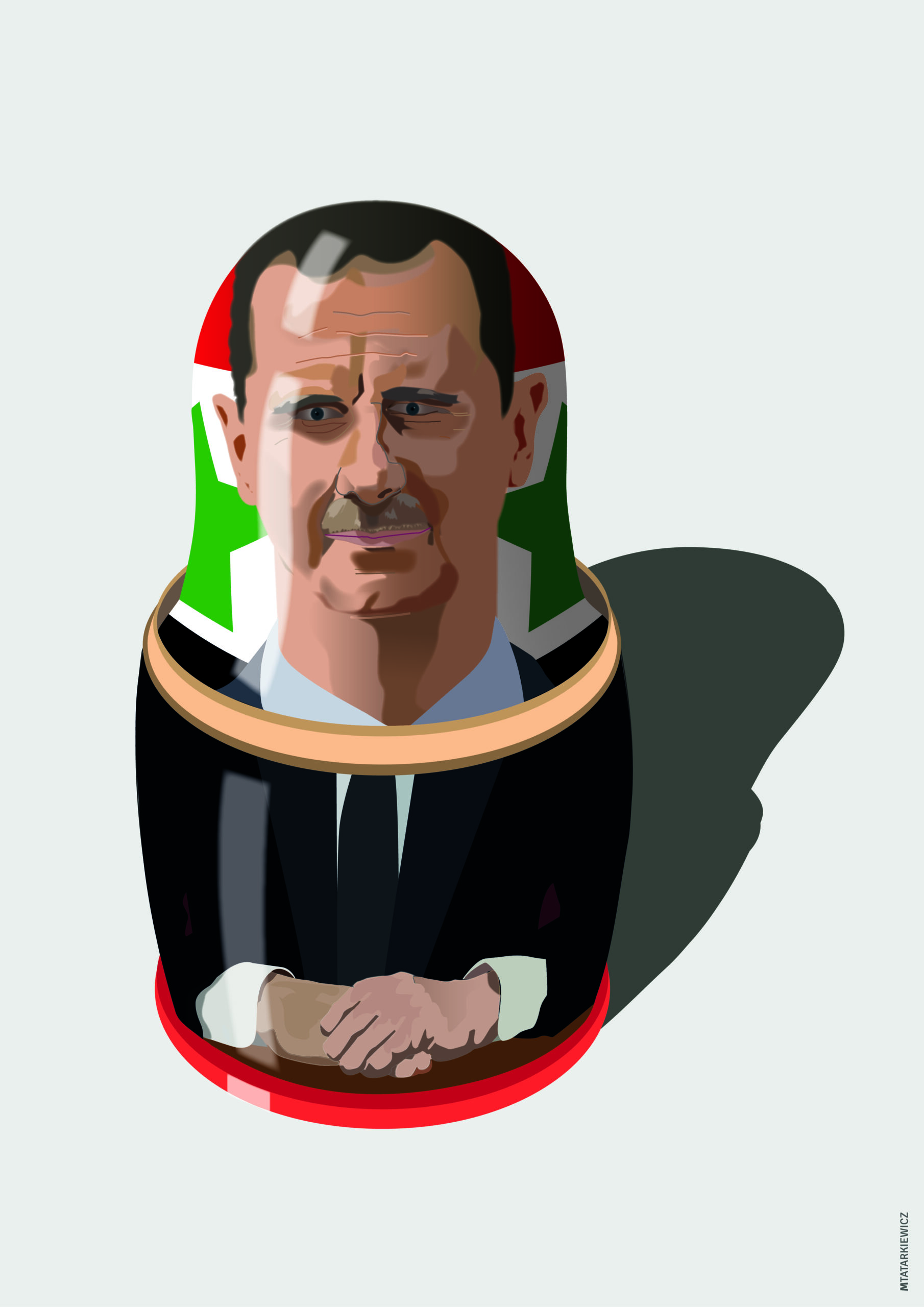
The drawing depicts a matryoshka doll featuring the image of Bashar al-Assad against the Syrian flag, nested inside a larger figure, of which only the lower part is visible – hands posed in the characteristic gesture of Vladimir Putin. This seemingly simple visual strategy functions as a multilayered political metaphor. The matryoshka structure has long symbolized dependency, hidden identities, and influence; here, it is used to comment on geopolitical relations and power dynamics in Syria. The work employs a restrained graphic language, where form and color reinforce the symbolic-political message, inviting viewers to reflect on mechanisms of power and contemporary conflicts.
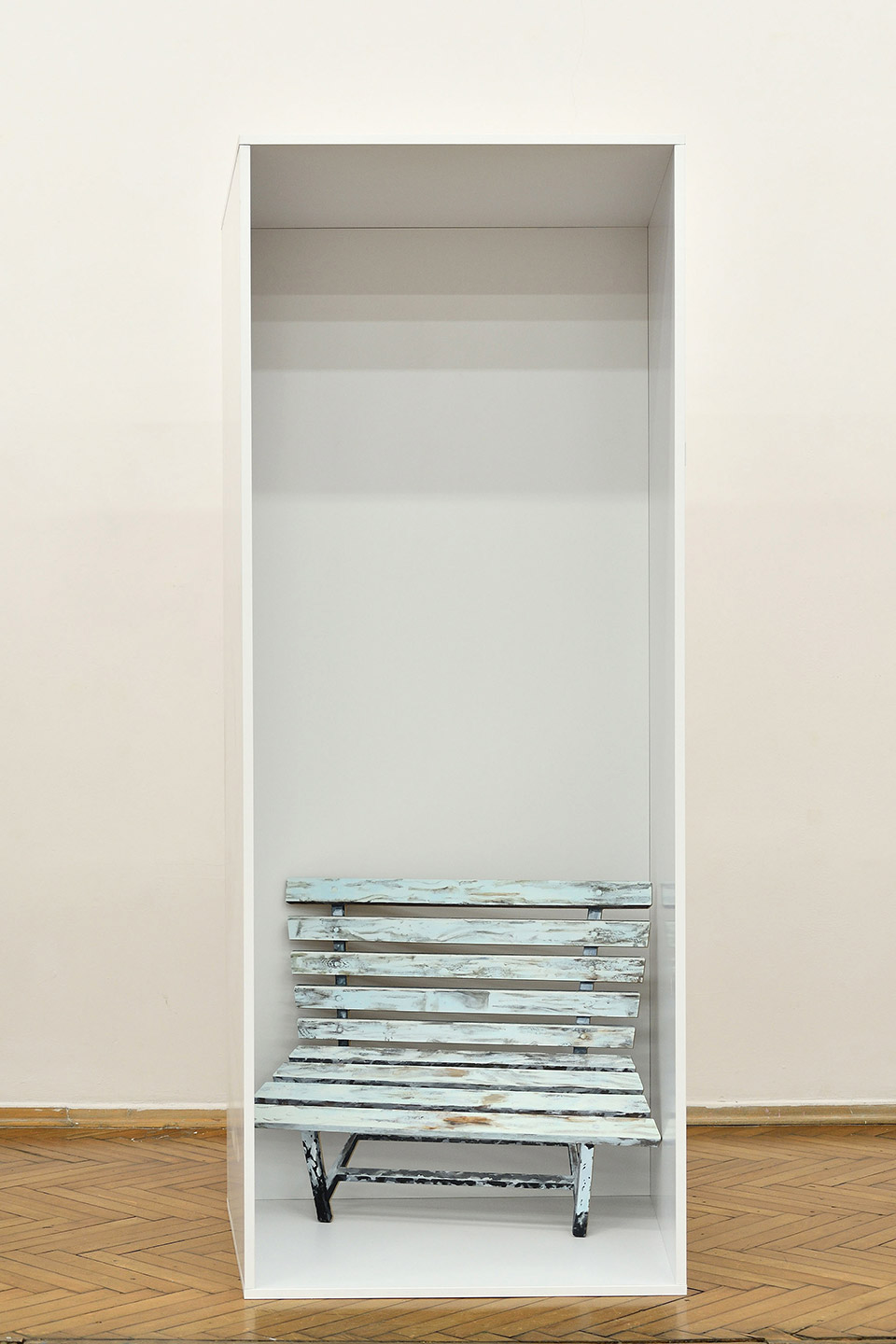
Bench (2025)
Technique: painted object, acrylic on MDF
Dimensions: 70×86 cm
Year: 2025
Venue: Group 404 collective exhibition Postcard from the Province / exhibition texts: M. Kurak, K. Piskorz / BWA Gallery, Zielona Góra
This work evokes a nostalgic vision of the province as a peaceful place, marked by neglected bus stops and benches in front of homes. Yet reality often diverges from this idealized image. The piece deceives the viewer with the illusion of a real bench
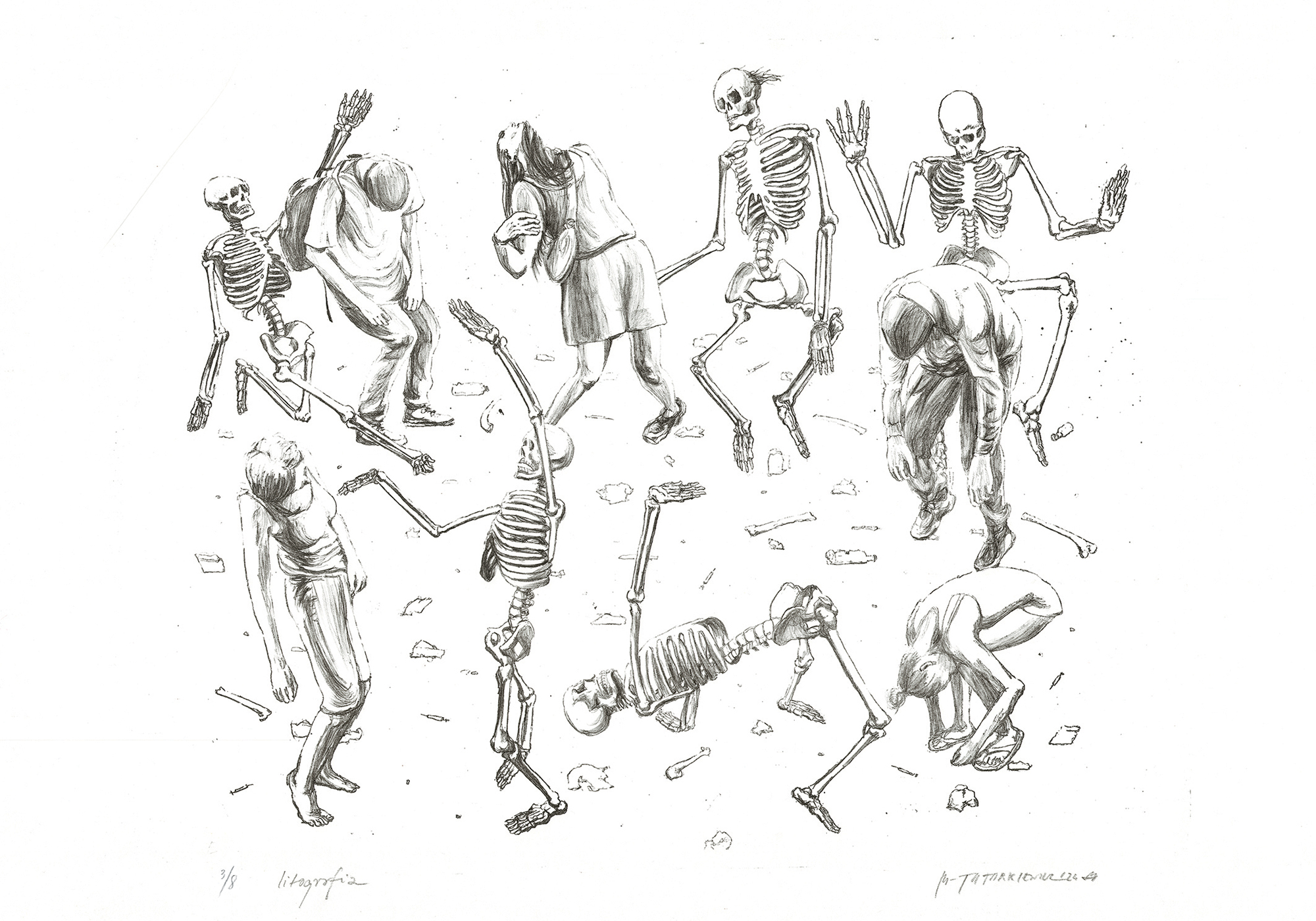
Let’s dance I (2024)
Technique: lithography
Dimensions: 70×100 cm
Year: 2024
The Let’s Dance lithographs address the alleviation of pain, both physical and psychological. The ironic “dance of death” (danse macabre) serves as a pretext for reflecting on the condition of the contemporary world. Fentanyl, a highly potent prescription painkiller, is strongly addictive, and when combined with other substances (e.g., xylazine), it can lead to profound stupor – commonly referred to as a “zombie state” – which often results in death.
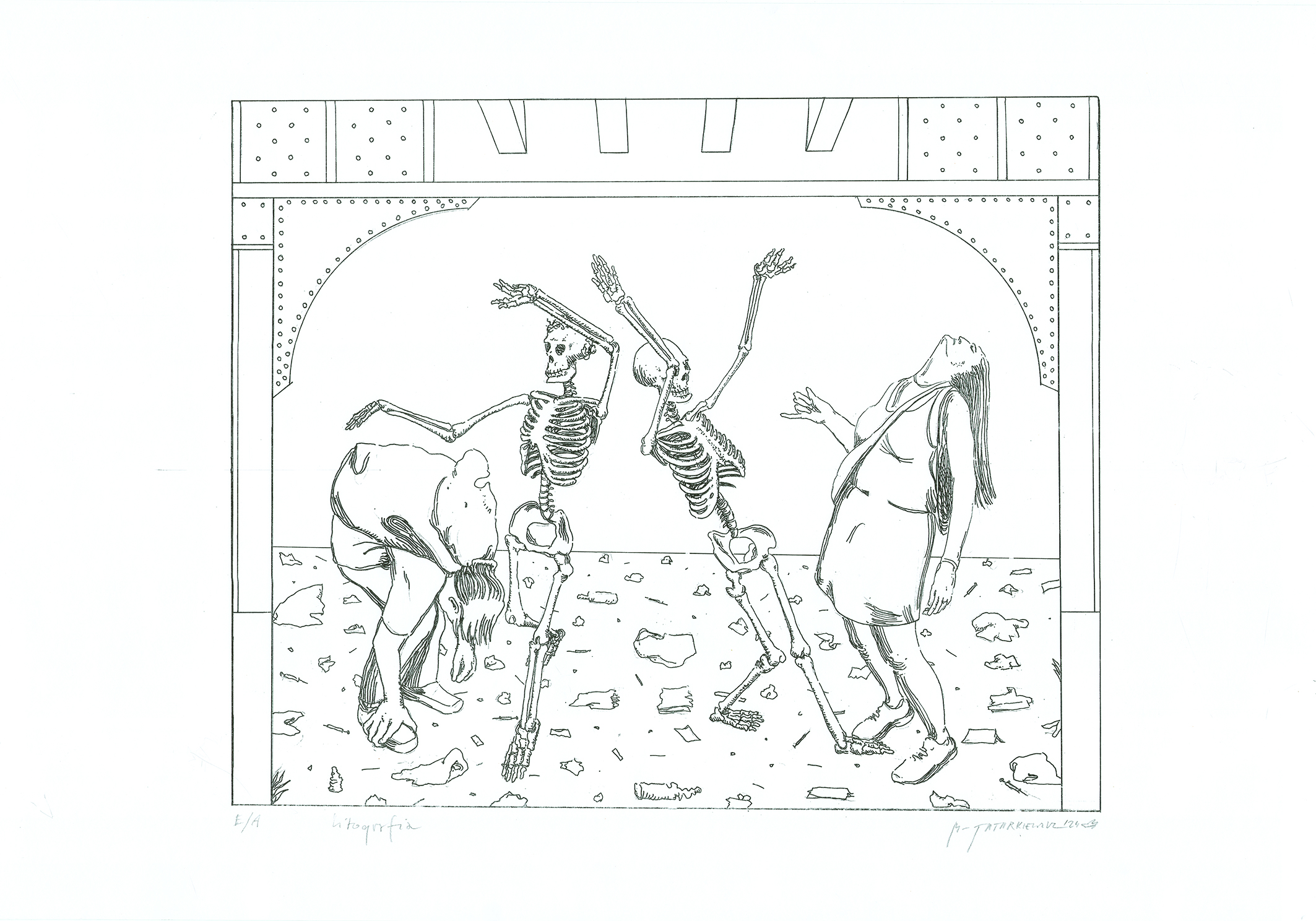
Let’s dance II (2024)
Technique: lithography
Dimensions: 70×100 cm
Year: 2024
The Let’s Dance lithographs address the alleviation of pain, both physical and psychological. The ironic “dance of death” (danse macabre) serves as a pretext for reflecting on the condition of the contemporary world. Fentanyl, a highly potent prescription painkiller, is strongly addictive, and when combined with other substances (e.g., xylazine), it can lead to profound stupor – commonly referred to as a “zombie state” – which often results in death.
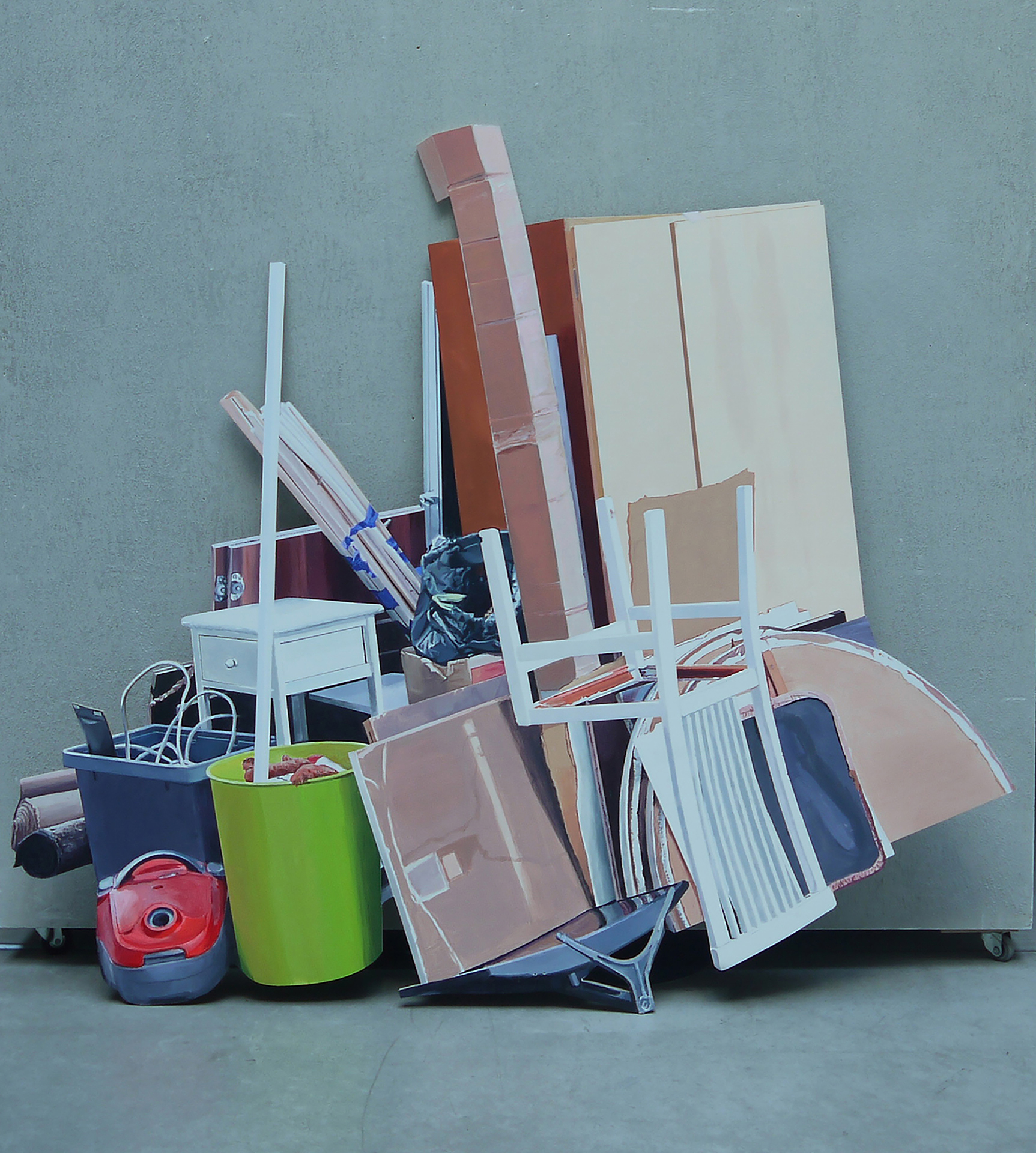
Relocation #1 (2024)
Technique: acrylic on MDF
Dimensions: 168 × 190 cm
Year: 2024
Relocation explores the journey of objects and the transformation of their meanings when removed from their original contexts. Displacement exposes the fragility of their status: something that seems worthless in one place may become a “treasure” elsewhere. Abandoned, recovered, and relocated objects testify to cycles of accelerated consumption and rapid loss of meaning. Abandonment does not always signify an end – sometimes it marks the beginning of a new narrative. The painted representation freezes the motion of the object, granting it a new identity and provoking reflection on value, attachment, and transience.
Hypocrisy (2021)
Technique: satirical drawing, digital print
Dimensions: A3
Year: 2021
Exhibited: International Exhibition SATYRYKON, Legnica (2023)
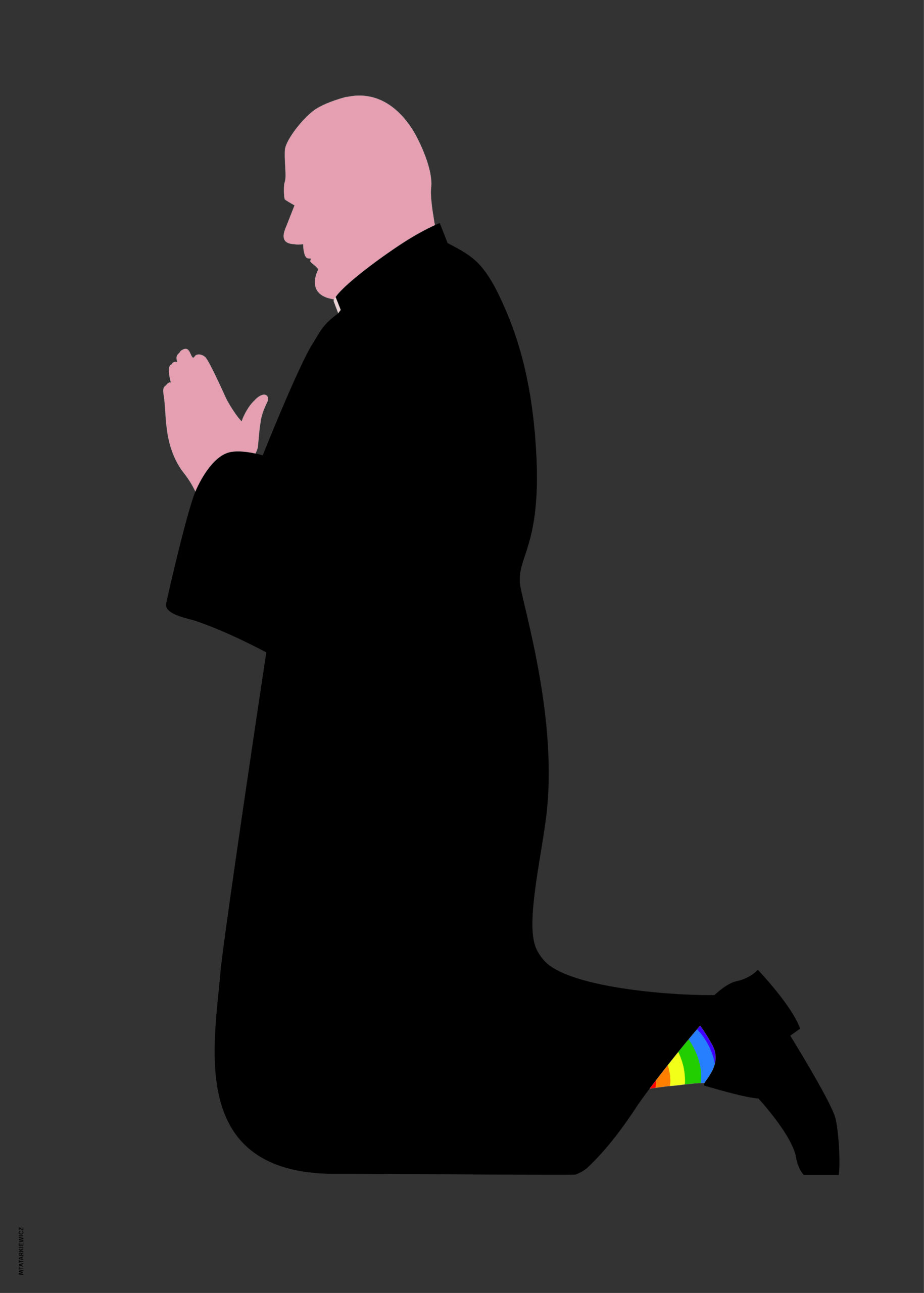
The work depicts a kneeling priest immersed in prayer, wearing colorful rainbow socks. It serves as a satirical critique of hypocrisy in the Catholic Church, employing irony and visual contrast as primary artistic tools. The restrained graphic language encourages viewers to reflect on contradictions within religious institutions and prevailing moral and social norms. The piece provokes contemplation on the mechanisms by which moral authority functions and the inherent contradictions embedded in norms and attitudes shaping contemporary social discourse.