Andrzej Bobrowski
He studied at the Faculty of Painting, Graphics and Sculpture of the State Higher School of Fine Arts in Poznań, graduating with distinction in 1990 from Professor Zbigniew Lutomski’s Woodcut Studio. He received his doctoral degree in 2001, completed his habilitation (post-doctoral studies) in 2004, and was awarded the title of Professor in 2012.
Since 1996, he has been affiliated with the University of Zielona Góra, where he leads the Serigraphy Studio at the Institute of Visual Arts, Faculty of Arts. Since 2005, he has also been associated with the University of the Arts Poznań (formerly the Academy of Fine Arts). Between 2016 and 2022, he served as Dean of the Faculty of Graphics and Visual Communication.
An artist, educator and organiser, he has supervised BA, MA and doctoral theses and has served as a reviewer in habilitation and professorial proceedings.
His artistic practice spans graphics, painting and spatial forms, including installations and objects. His work has been presented in solo exhibitions, including at the Lubusz Land Museum in Zielona Góra and the Leon Wyczółkowski District Museum in Bydgoszcz.
He regularly participates in group exhibitions at leading galleries and cultural institutions in Poland and internationally, including in Austria, China, the Czech Republic, Greece, Japan, Canada, South Korea, Germany, Portugal and Romania.
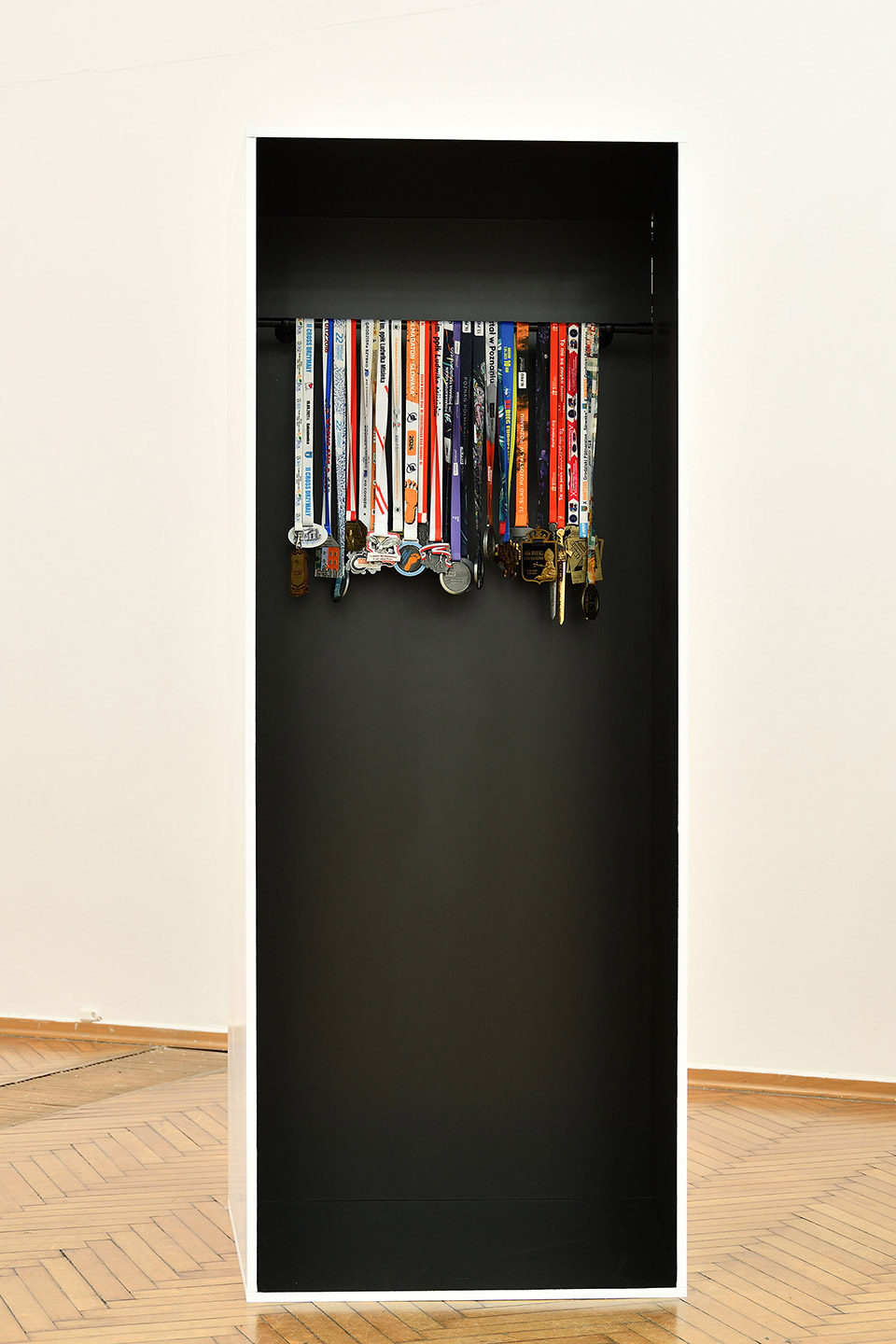
Run (2025)
Year: 2025
Venue: BWA Gallery in Zielona Góra
The presented work, depicting a collection of sports medals within a minimalist display structure, symbolically addresses the theme of individual effort in the context of collective experience and social competition. Within the framework of the exhibition, the piece engages with the role of the province as a space where global processes undergo local reinterpretations.
An important element of the exhibition was its display concept, which involved presenting the works in specially designed white display structures whose form referenced the architecture of the panopticon. This solution emphasized both the autonomy of individual works and their shared participation in the curatorial narrative, creating a coherent interpretative field. Contrary to stereotypes, the province is not depicted here as a space of stagnation or isolation, but rather as a site of creative reinterpretation of global processes and a laboratory of social transformation.
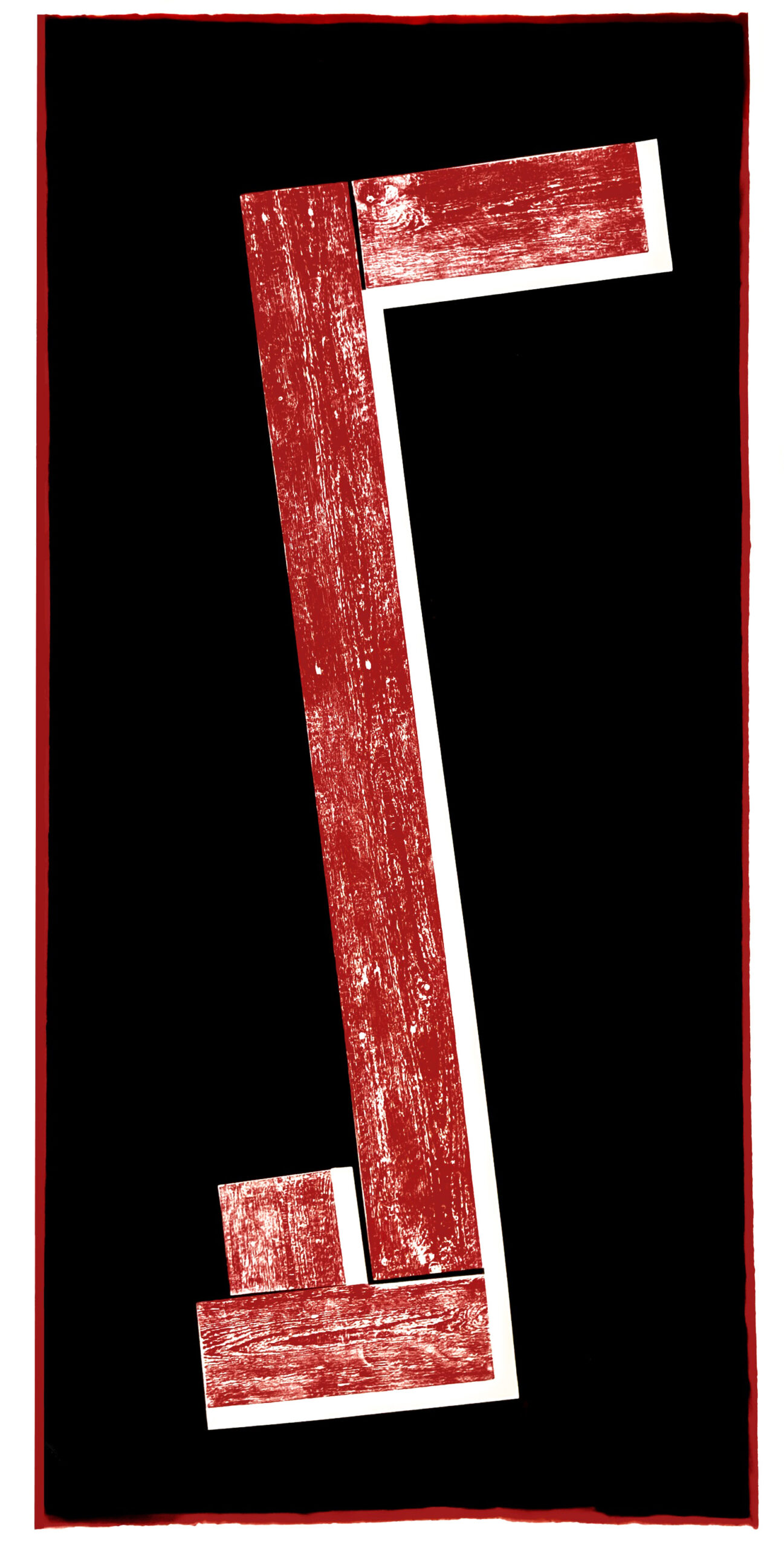
Rodło (2023)
Technique: relief print, stencil
Dimensions: 262×124 cm
A pine board – printed in the shape of the Rodło, a symbol of the Polish community in Germany – originates from a forest planted over 80 years ago near Babimost. The forest stood as a silent witness to the history of these lands. The artist employs the symbolic potential of white, red, and black – colors associated with war, mourning, patriotic symbolism, and innocence—to invite viewers into a range of reflections and emotional responses.
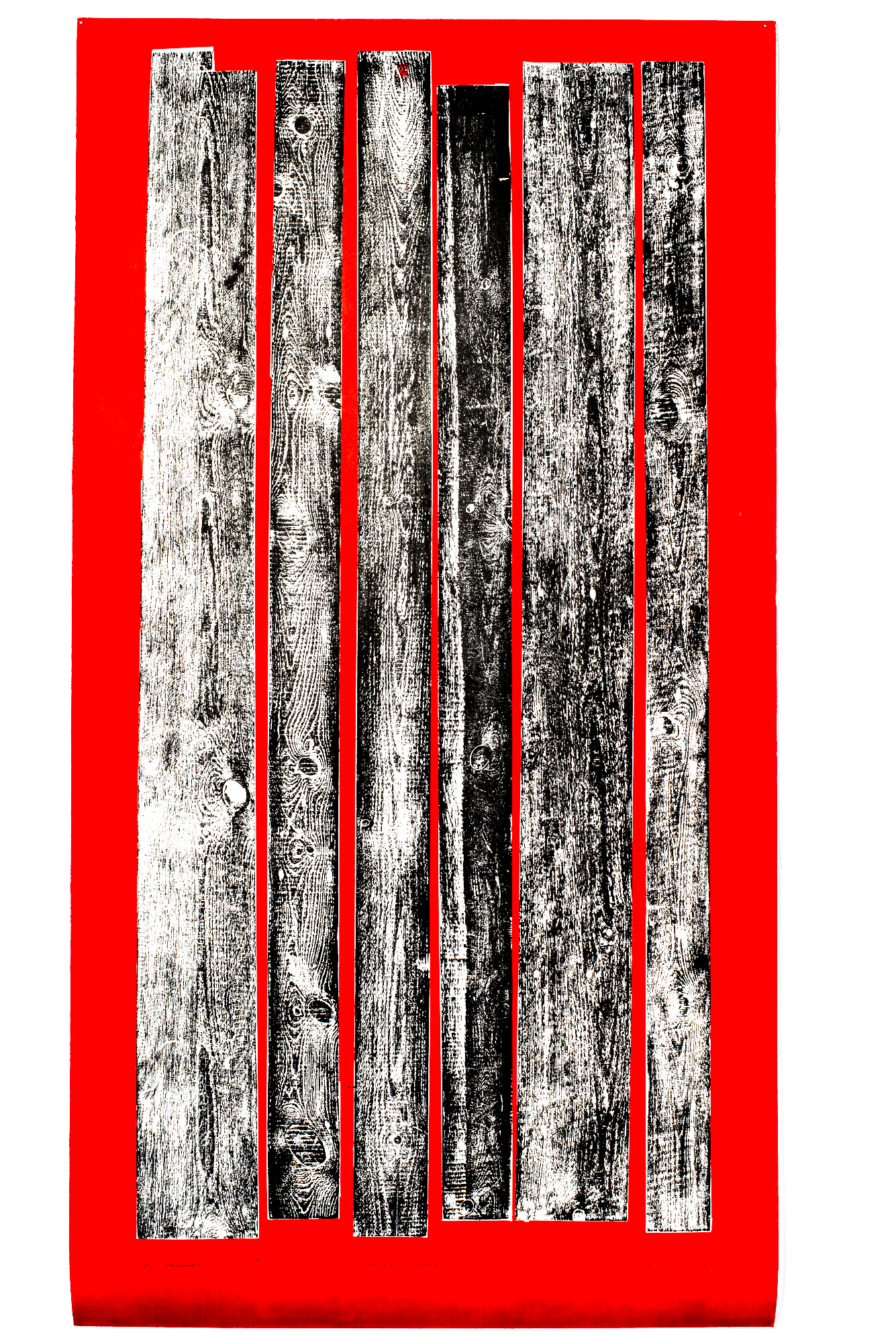
Gate (2022)
Technique: relief print, stencil
Dimensions: 225×120,5 cm
The work is based on the juxtaposition of raw wooden planks with a pronounced natural grain, forming a partially permeable barrier behind which an intense, symbolic red emerges. The color acts as a pressing force, making it difficult to cross the boundary and creating tension between openness and protection.