Stefan Ficner
Born in 1952, he studied at the State Higher School of Fine Arts in Poznań (now the Magdalena Abakanowicz University of the Arts Poznań), graduating in 1981 from the Lithography Studio under Professor Lucjan Mianowski and the Poster Studio under Professor Waldemar Świerzy.
He is a professor at his alma mater, where he leads the Lithography Studio. His artistic practice centres on lithography based on traditional techniques using lithographic stones as matrices. Between 1983 and 1990, he ran the independent, non-commercial Wielka 19 Gallery in Poznań, organising approximately 200 exhibitions featuring artists from Poland and abroad. From 1991 to 2005, he directed the Lithography Studio at the Institute of Art Education of the Higher School of Pedagogy (now the University of Zielona Góra). Since 1997, he has been co-organising the Student Graphics Biennale. He is the initiator and editor of the publication Podręcznik Warsztatowy. Grafika Artystyczna [Workshop Handbook: Graphic Arts] and the author of the chapter on lithography included in the volume (Academy of Fine Arts in Poznań, 2007).
He was awarded a scholarship from the Fondation pour une entraide intellectuelle européenne (1988), received the First Prize of the Minister of Culture and Art (1990), and was awarded the Medal of the City of Poznań for Artistic Achievement (1991). His works are held in public and private collections in Poland and internationally.
Throughout his artistic career, he has been devoted to graphic arts.
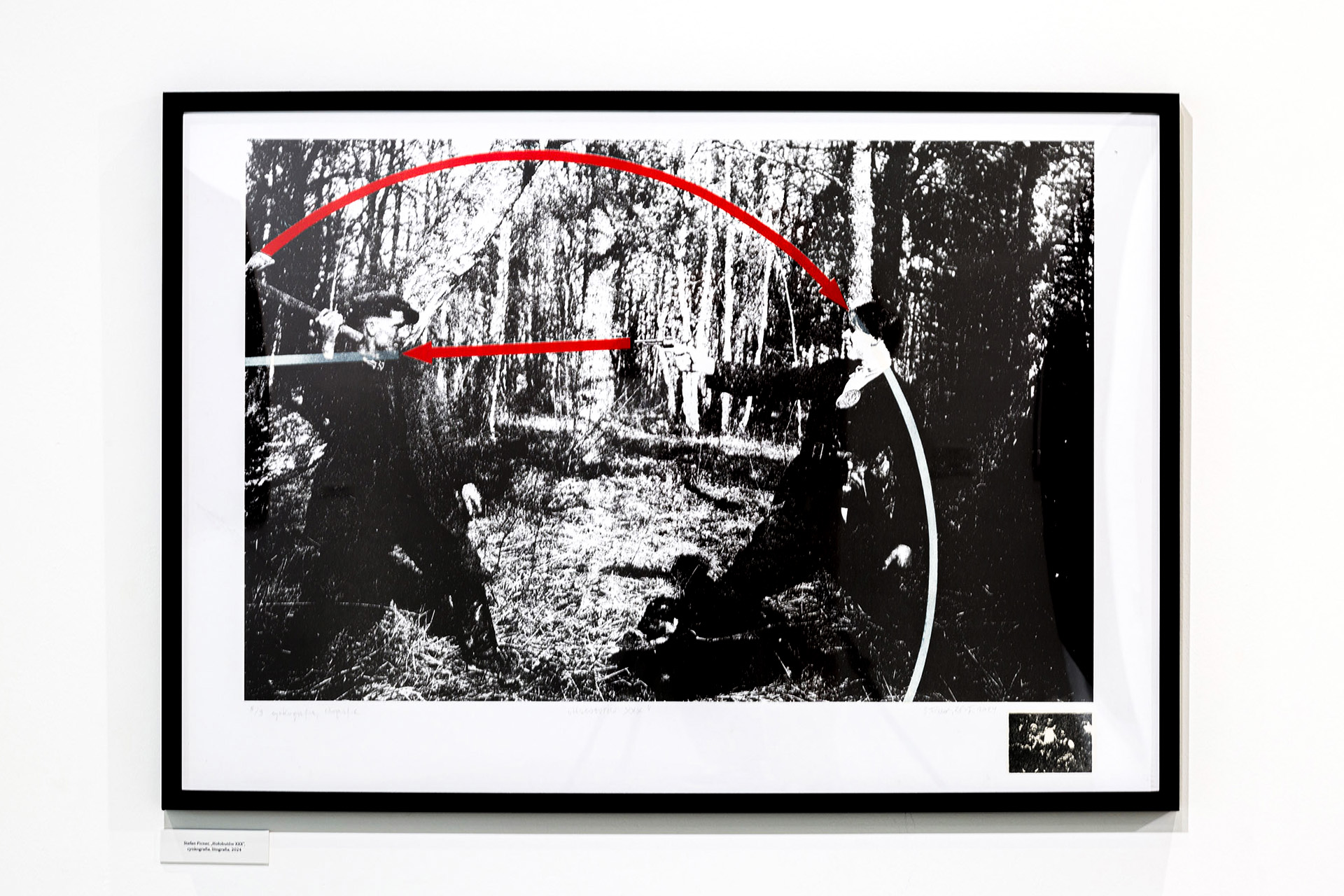
Hołobutów XXX (2024)
Technique: zincography, lithography
Dimensions: 70×100 cm
Year: 2024
The work was presented as part of the exhibition “Parallel Lives” (UAP City Galleries, Nowa Scena UAP in Poznań), which formed part of an international project by M. Zancanelli devoted to cultural analogies and European heritage.
The print depicts a black-and-white photograph of two figures in a forest, aiming pistols at each other. Red and blue arcs and arrows cutting across the composition introduce tension and a symbolic dimension to the scene. The juxtaposition of archival photography with graphic intervention emphasizes both the dramatic intensity of the moment and the absurdity of violence embedded in the cyclical nature of history. The “Hołobutów” series is based on family negatives from the years 1930–1939, showing life in the area of Stryja (present-day Western Ukraine). Viewing these materials through the lens of his family’s wartime experiences, the artist engages in an intimate dialogue with the past. By intervening in the photographs from the position of “one who knows,” he attempts to preserve the world before catastrophe and to grant it a sense of continuity. Within these seemingly idyllic scenes, the anxieties of the 1930s emerge—uniforms, weapons, and the posed figures of men anticipating the coming war.
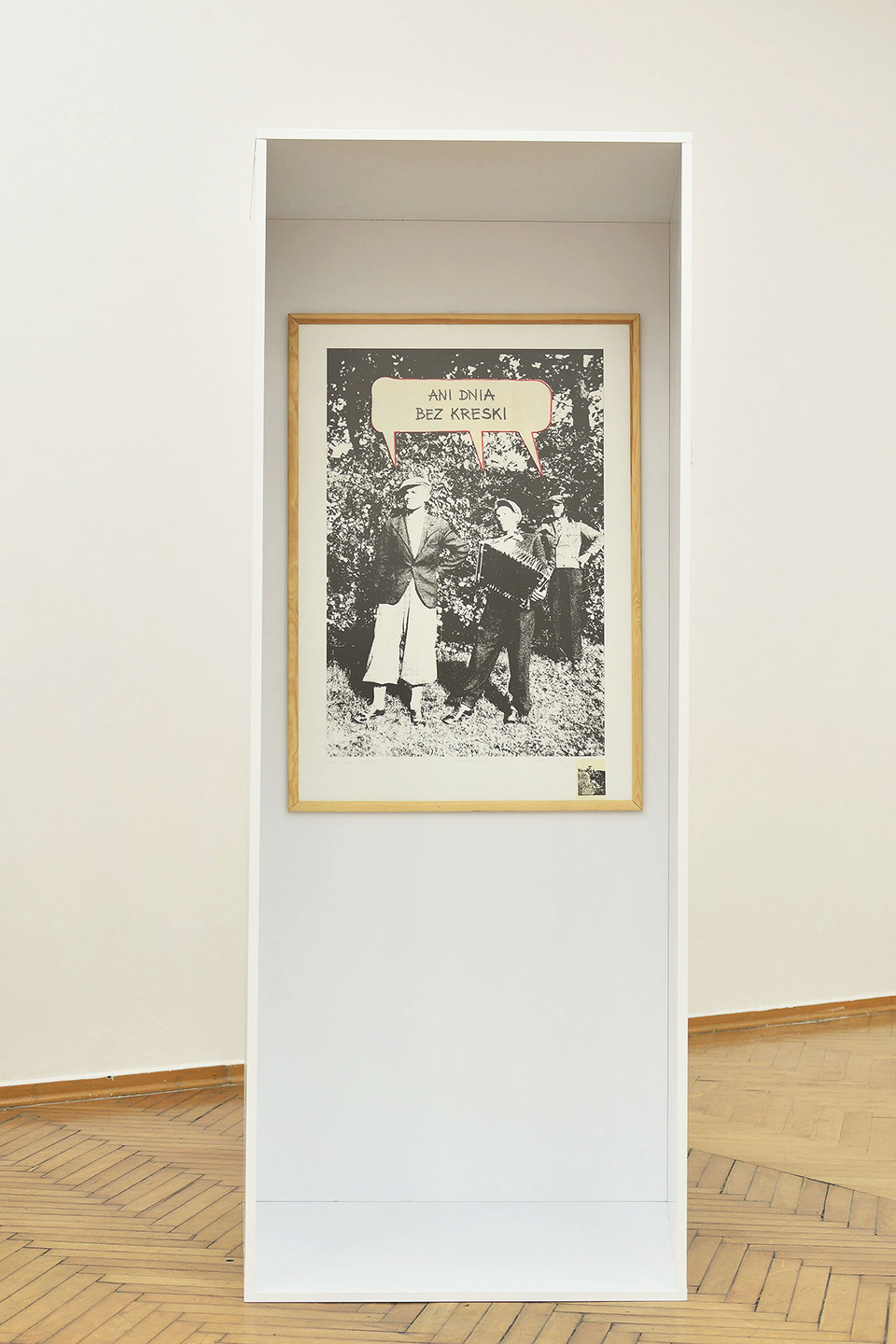
Hołobutów XXVII (2023)
Technique: zincography, lithography
Dimensions: 70×100 cm
Year: 2023
The work was first presented as part of the Group 404 collective exhibition “Postcard from the Province” at the BWA Gallery in Zielona Góra in 2025.
The print depicts a black-and-white photograph of three figures standing in relaxed poses against a backdrop of trees. Comic-style speech bubbles bearing the phrase “Not a day without a line” (outlined in red) are superimposed onto the image. The artist’s intervention introduces an ironic and self-ironic tone—the archival, idyllic scene becomes a contemporary commentary on the need for daily creation and perseverance in artistic practice. The work is part of the “Hołobutów” series, based on family negatives from the years 1930–1939. It reflects on memory and transience, as the artist, intervening in historical photographs, creates a bridge between past and present.