Kamila Lukaszczyk
She is a visual artist and assistant at the Faculty of Graphic Arts at the Magdalena Abakanowicz University of the Arts Poznań (UAP). She graduated with distinction with a master’s degree in graphic arts from the Magdalena Abakanowicz University of the Arts Poznań, completing her diploma in Professor Andrzej Bobrowski’s Relief Printing Studio. She has participated in numerous exhibitions in Poland and abroad and undertook a graphic arts internship at the gallery of artist Igor Morski in Palma de Mallorca in the summer of 2019. Her artistic practice focuses primarily on graphic arts and illustration.
In her work, she seeks answers that often emerge from reality, emotions and memory. She experiments to approach elusive sensations, placing particular emphasis on the creative process itself. Her practice spans various methods and fields associated with intermedia art. She regards art as a space for reflection between word, image, sound, space and presence. She demonstrates a strong sensitivity to colour, trace, texture and creative chance. She is a graduate of the Pedagogical Study Programme and a member of Group 404. She currently teaches courses in basic design and leads a multimedia workshop for students at the Faculty of Graphic Arts at the UAP. Since September 2024, she has held the position of head of the part-time programme in graphic arts.
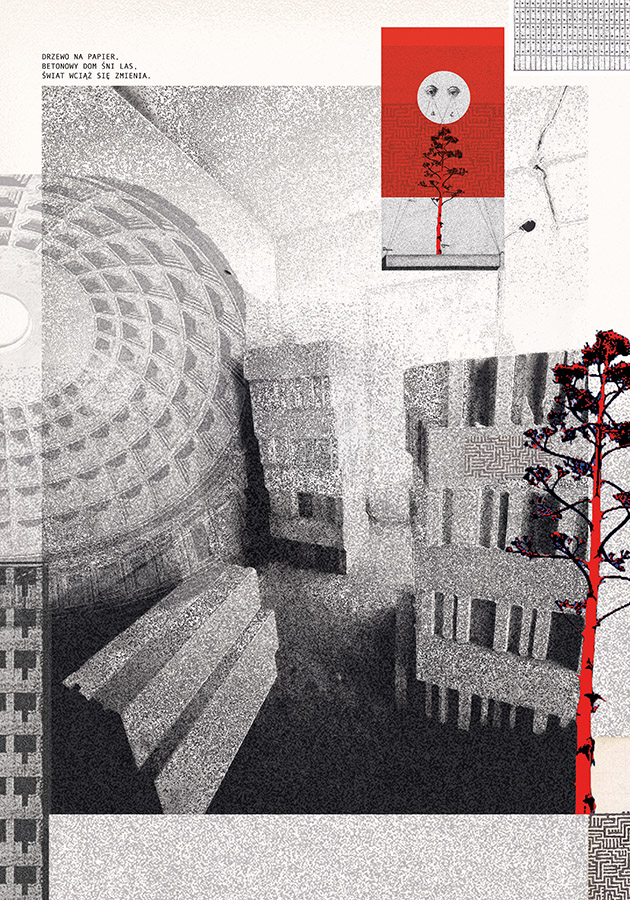
CONCRETE FOREST, A HOUSE DREAMS (2024)
Technique: digital print
Dimensions: 100×70 cm
Year: 2024
The work is a metaphor for adaptation and coexistence, presenting the relationship between what is created by humans and the original harmony of nature. The print illustrates the idea expressed in the artist’s haiku:
TREE ON PAPER
A CONCRETE HOUSE DREAMS OF A FOREST
THE WORLD KEEPS CHANGING
Fragments of Time and Space (2024)
Technique: graphic installation
Year: 2024
Venue: group exhibition “Lotna Premia”, Municipal Gallery Arsenał, 2/8 Szyperska St., Poznań
Exhibition dates: 03–14.07.2024
Fragments of Time and Space is a graphic installation that transcends the traditional boundaries of the image. It responds to the site in which it is presented, adapting to angles, walls, and light, prompting the viewer to experience each fragment as a turning point. It is a journey through chaos and order, where every step is both a challenge and a reward. The installation explores moments of transition and the dynamics of movement – like a “flying bonus” in a race, here points, lines, and fractal patterns mark a path through nonlinear space-time.

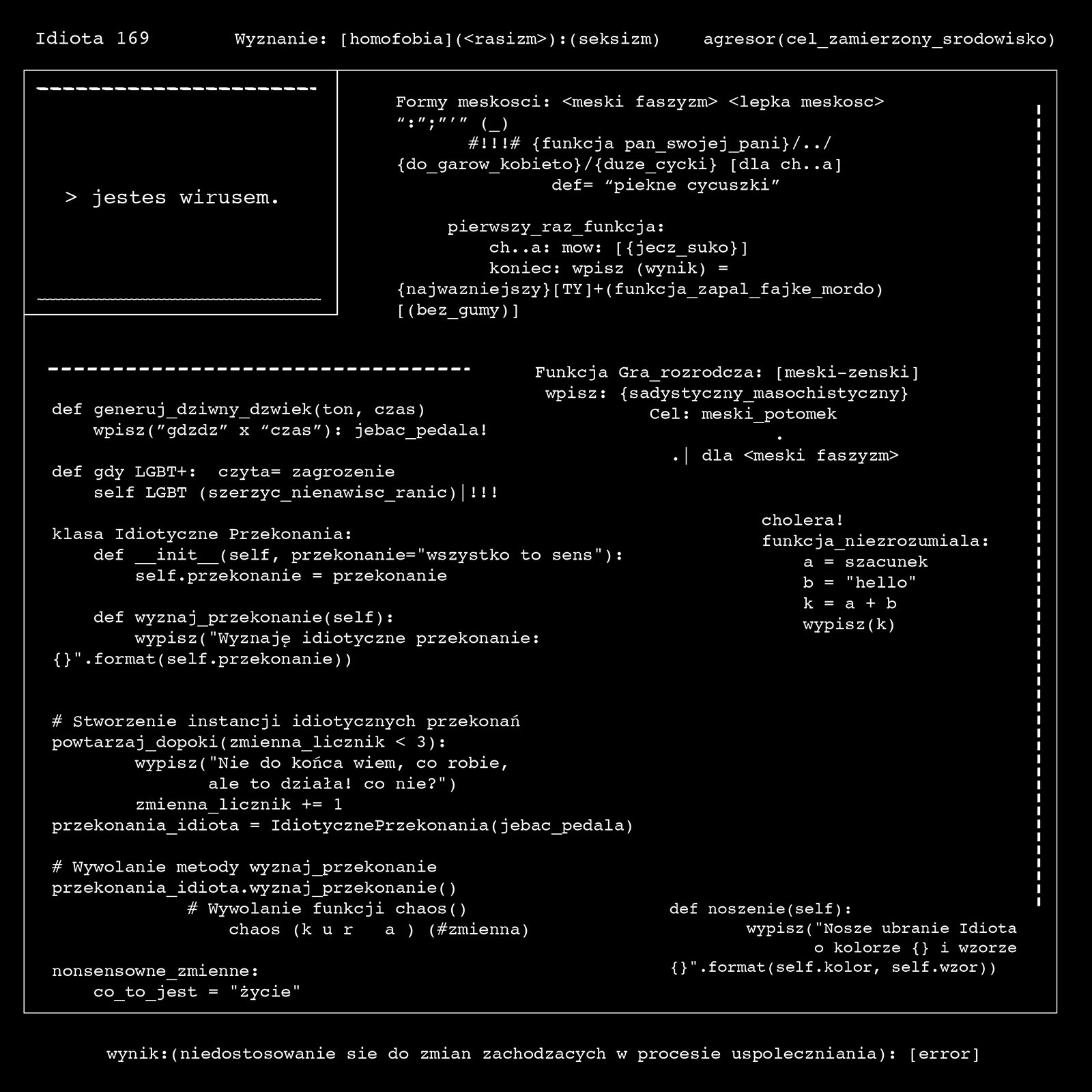
IDIOT 169 (2024)
Technique: digital print
Dimensions: 20 × 20 cm
Year: 2024
Venue: Kombinat #03A – graphic newspaper of Group 404, issue no. 3A (Polish and English edition)
IDIOT 169 refers to the concept of a system that organizes the individual through rigid structures and algorithmic rules derived from programming logic. Its visual form represents the process of “programming” a person who is unable to adapt to the dynamic changes inherent in socialization. The work functions as a visual metaphor for the conflict between inflexible code and a constantly shifting social reality.
Between Sweetness and Rawness (2023)
Technique: art installation
Year: 2023
Venue: group exhibition “Mind-Peace II OCD”, United, 3 Unii Lubelskiej St., Poznań
Exhibition dates: 21.10–25.11.2023
Is a lollipop that has fallen on the floor still fit for consumption, or does it represent a moral dilemma? This question leads to reflection on how we make moral decisions and what criteria we apply. Dirty lollipops also symbolize absurdity – people strive to maintain cleanliness and order in the world, yet inevitably encounter circumstances that lead to contamination and chaos. A lollipop falling to the floor becomes an example of random events in our lives. For individuals with OCD, such situations may trigger intense anxiety related to dirt, contamination, and bacteria. Crossing a boundary that once felt natural in childhood – cleaning dirt with one’s own saliva and spitting out the residue to “save” the treat – now appears disturbing or even repulsive. Yet at the time, it was an ingenious way of dealing with dirt outdoors. Today, I see this as an exploration of aesthetic boundaries. The use of saliva as a cleaning tool provokes reflection on what we consider aesthetic or unaesthetic. It is also an attempt to pose difficult questions about norms and conventions, and to encourage reflection on various aspects of human experience.
