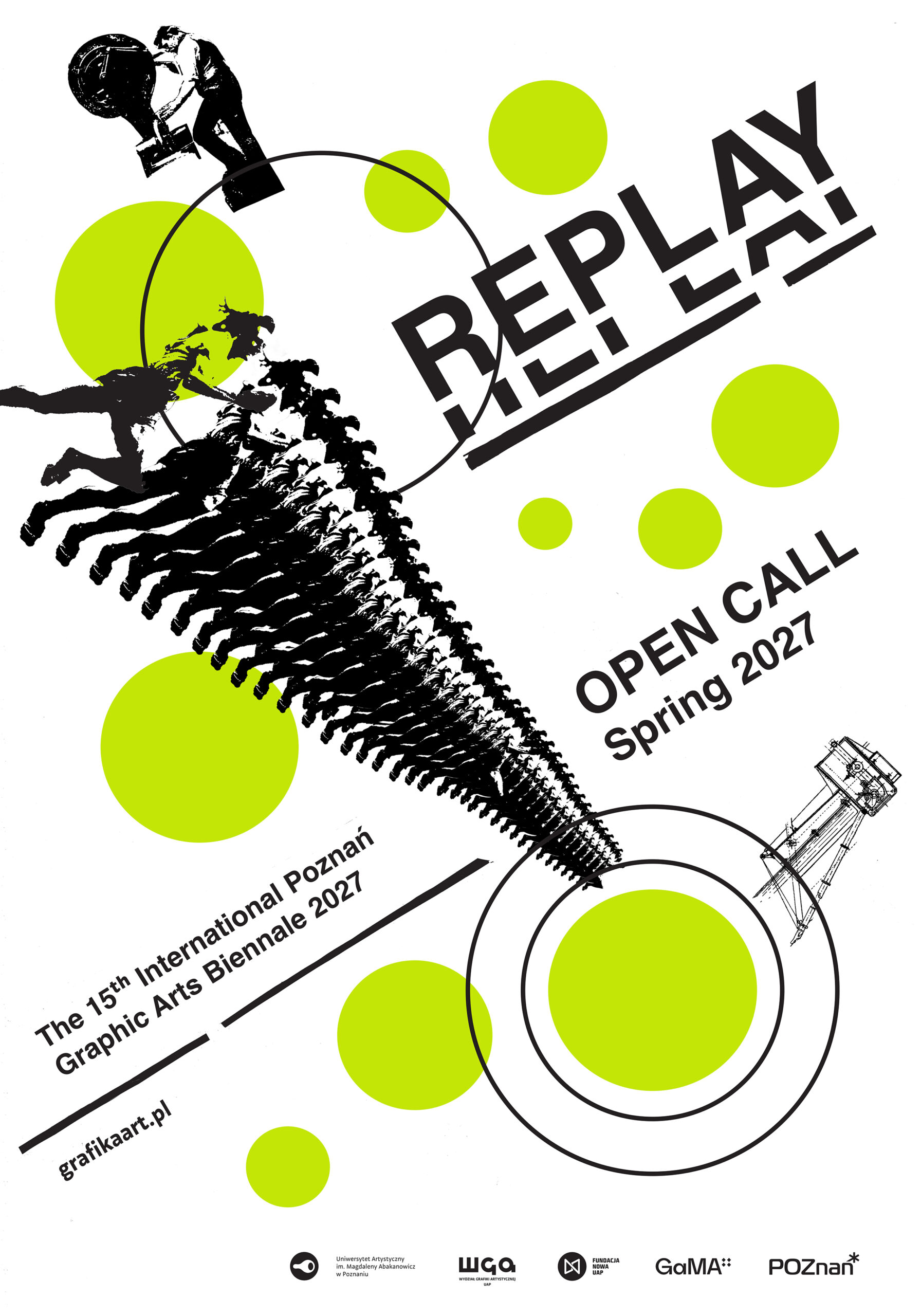
BIENNALE / SPRING 2027
The 15th International Poznań Graphic Arts Biennale – REPLAY
SUBMISSION DEADLINE : 5.02.2027
The theme of the 15th International Graphic Arts Biennale in Poznań, to be held in spring 2027 in Poznań, is REPLAY.
The theme of this year’s competition addresses repetition as a frequently employed artistic strategy (mimesis), realised in carefully selected forms. Creative engagement with one’s surroundings involves both exploring and transforming reality. Understood in this way, repetition becomes a platform for analysing contemporary culture and society. It encompasses both local and global phenomena, viewed through political, sociological, and historical tensions that shape the role of art today. The competition is open to adult creators from all over the world.
In stage one, authors are invited to submit preview files of their original graphic works created between 2025 and 2027, together with a brief description of the concept and technique. Submissions must be completed by 5 February 2027 via the online Application Form, which will be available from early November 2026 on grafikaart.pl. Authors qualified by the jury for stage two of the competition deliver their original works in physical form to the address provided on grafikaart.pl. Works nominated for awards will be presented at the post-competition exhibition organised at the Municipal Gallery Arsenał in Poznań and published in the accompanying exhibition catalogue. Further information about the competition is available on grafikaart.pl.
We cordially invite you to participate in the 15th International Graphic Arts Biennale in
Poznań.
Updates will be published soon on grafikaart.pl and on our social media profiles.
Stay tuned!
Replay
Creative activity is commonly positioned in opposition to repetition. In contemporary culture, the repeated presentation of the same motif is often regarded as a secondary gesture, lacking value. By contrast, privilege is accorded to those attitudes and practices that invoke innovation and originality, provided they are socially accepted, affirmed, and promoted within cultural circulation. Adopting an evaluative perspective grounded in contemporary categories derived from the ideas underpinning the dominant system of organising social behaviour – namely capitalism – makes it clear that the definition of the new is not neutral. Rather, it reveals a network of dependencies tied to the logic of productivity, market competition, and a constant imperative to differentiate. Novelty thus functions less as a cognitive or aesthetic category than as a value conditioned by usefulness, visibility, and the capacity to circulate within economic and symbolic exchange.
The operation of this economic system rests on incessant processes of stimulation and adaptation, driven by mechanisms that simultaneously shape its cyclical dynamics and its expansive character. The pursuit of new strategies of capital accumulation compels, among other things, the annexation of an ever-widening spectrum of human activity. Consequently, domains that ostensibly position themselves in opposition to this system are also incorporated into it. One of the most illustrative examples of this mechanism is the use of Che Guevara’s image in the mass production of clothing and gadgets. Any sphere of activity – even one that most emphatically asserts its autonomy – can, under appropriate conditions, be absorbed into the system of capital accumulation. What emerges here is a dependency based on the principle that the more controversial and media-effective a form or practice, the more readily it becomes integrated into the dominant order. As a result, actions based on direct repetition and realised within a short temporal interval in relation to existing forms demonstrate a lower capacity to stimulate consumption and, consequently, reinforce the prevailing system to a lesser degree.
It should be noted, however, that elements rejected or temporarily displaced as inadequate often return to circulation after some time, once again stimulating economic development. This mechanism is evident both on the micro-scale of trends and fashions – where recourse to the past constitutes a common strategy for generating new styles – and on the broader historical plane encompassing successive cycles of capitalist transformation. In this context, Giovanni Arrighi describes ‘systemic cycles of accumulation’ as a process in which ‘this recurrent revival of previously suspended strategies and structures of accumulation generates a pendulum-like movement back and forth …’.[1] When the progressive element is abstracted from this account, repetition does not rely on an ideal form functioning in the realm of abstraction; rather, it invariably contains an element of novelty. It cannot be reduced solely to a change of context or a shift in interpretative frameworks, but possesses an ontological dimension that refers to the singularity of being. In this sense, repetition does not amount to mechanical reproduction but constitutes a process in which each subsequent project introduces difference, inscribing it into the very structure of existence.
The transformative character of repetition situates each successive realisation as a variant of the preceding one, rather than as a simple copy. From this perspective, repetition also reveals – paradoxically – an emancipatory potential. Operating within existing structures and schemas, it does not merely reproduce them, but introduces fissures, displacements, and differences that enable them to be challenged from within. This mechanism finds its analogies in post-artistic practices which, by embedding themselves in everyday activities and responding to concrete problems and dysfunctions of the prevailing system, simultaneously render that system problematic. This occurs through the introduction of non-obvious and singular elements, arising not from a pursuit of formal novelty but from a precise selection of means.
Understood in this way, repetition enables a release from the pressure of innovation conceived as an end in itself – a pressure also observable within the field of art, where it often takes the form of producing so-called ‘tricks’: repeatable and easily recognisable formal strategies perceived as signs of novelty within the art circulation. The areas of practice emerging from modern social reality remain entangled in processes of separating individual forms of activity, which facilitates their incorporation into the dominant system based on capital accumulation. In this context, artistic practices focused exclusively on their assigned tasks – such as reflection on the medium, the production of new forms, or conventional references to existing reality – not only impede the possibility of moving beyond prevailing systemic frameworks, including the logic of consumption, but also contribute to the mechanisms of their reproduction.
Conceived as a process of modification and reuse, repetition creates the conditions for art’s relational engagement with its environment (mimesis), its reinterpretation through a new mode of seeing, and its inscription into the language of art as a tool for revealing alternative ways of shaping the lived space of individuals and communities. As a result, art emerges here as a domain in which new visual and stylistic qualities do not function autonomously but become instruments for the critical formation of social sensibility and cultural forms of communality.
Maciej Kurak
[1] Giovanni Arrighi, The Long Twentieth Century: Money, Power, and the Origins of Our Times, London, New York:Verso, 1994, p. 219.